Small Business AI Search Guide
Can Better Website Content Help Your Business Show Up in AI Search?
Useful website content can give Google and AI-powered search systems more business-specific information to discover, understand and potentially surface or reference. But there is no special content formula that guarantees your business will appear in an AI-generated answer.
Better content can create more useful information around your business. That can help search systems understand your services, expertise, customer questions and relevant context. It can create more opportunities for discovery—but it cannot guarantee an AI citation, recommendation, ranking or lead.
Search Is Expanding
Potential customers do not always search with a short list of keywords anymore.
Someone looking for a local service may still type a traditional search into Google.
But that same person may also ask a longer question, compare options, describe a problem or use an AI-powered search experience to help understand what to do next.
That changes the range of information a useful business website may need to communicate.
A homepage and a few service descriptions can establish the business. They usually cannot answer every useful question surrounding the business.
Your core website can explain the business. Useful supporting content can create additional layers around the services, expertise, problems and questions connected to that business.
From Keywords to Questions
People can search in more conversational ways.
AI-powered search experiences make it natural for people to ask detailed questions and follow-up questions instead of reducing every need to two or three words.
For a local business, that means useful search demand can exist around the questions that happen before someone is ready to call.
Start With the Foundation
AI visibility starts with being understandable.
Before thinking about articles, the website itself should make the basic business information clear.
Who is the business? What does it do? Where does it provide those services? What expertise does it have? How can someone take the next step?
Supporting content works best when it expands a clear foundation rather than trying to compensate for a confusing website.
What Content Adds
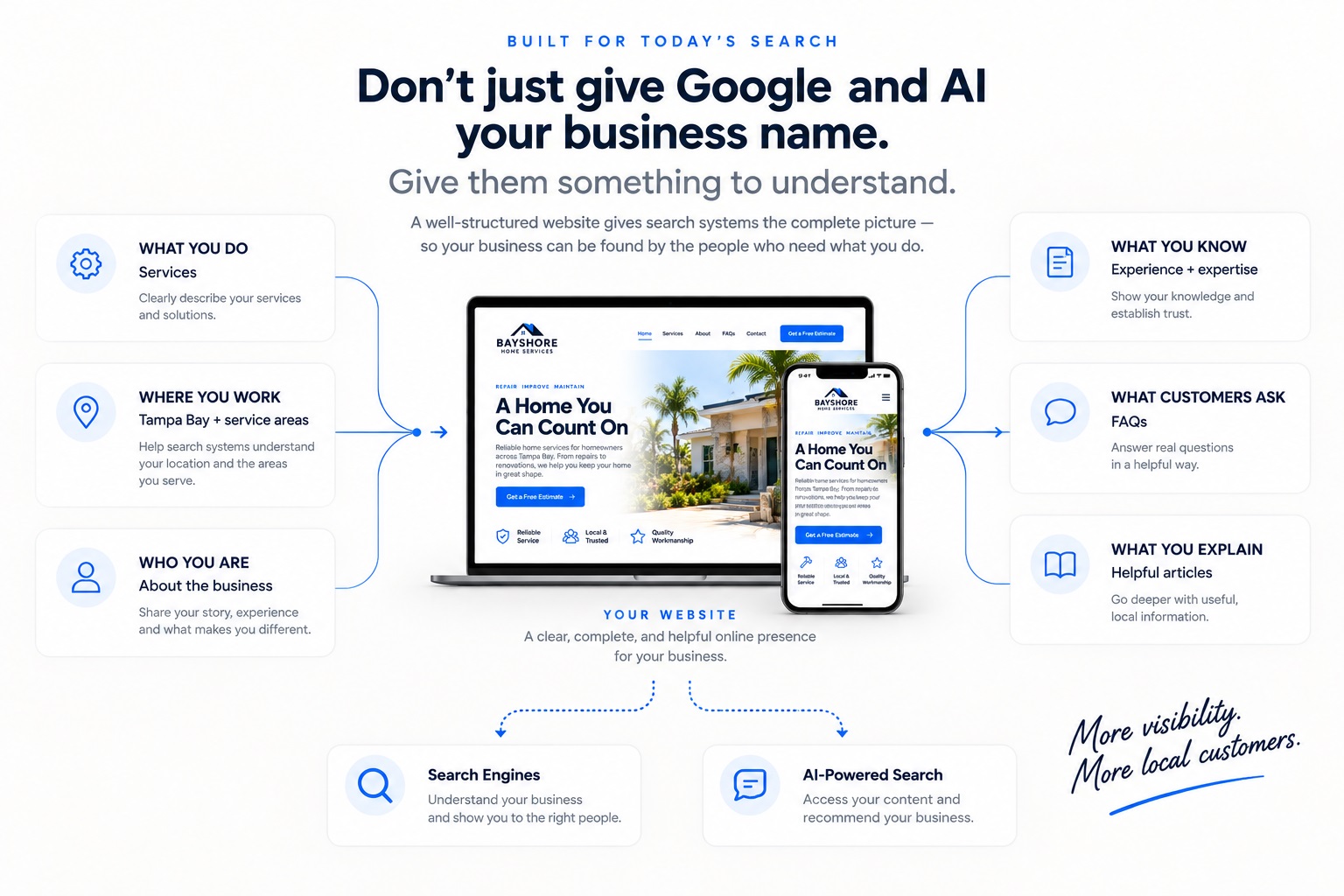
Your website establishes the business. Your content builds layers around it.
A useful content library can expand the amount of accurate, business-specific information available around the company’s work.
Explain individual services, when they are useful, common issues surrounding them and what customers should understand before making a decision.
Give the business room to explain what it knows from actually performing the work rather than relying only on short promotional claims.
Address the real situations that cause customers to start searching in the first place.
Answer questions customers repeatedly ask before, during or after deciding to use the service.
Help potential customers understand choices, tradeoffs, processes and what factors they should consider.
Add accurate information about conditions, terminology, situations or market-specific considerations that genuinely affect the business and its customers.
Start With Real Customers
Your customers are already giving you content ideas.
One of the best sources of useful website content is not a keyword generator.
It is the conversation happening between the business and its customers every day.
The questions customers repeatedly ask reveal where they need more information—and where the business has knowledge worth explaining.
What Better Content Looks Like
Useful. Specific. Based on something the business actually knows.
The goal is not to produce the largest possible number of articles. The goal is to publish information worth having on the website.
Start with something a real customer would genuinely want to understand.
Add knowledge, examples, observations and explanations that come from the business’s actual work.
Answer the question well enough that the visitor learns something useful instead of encountering thin filler.
Use descriptive headings, readable sections and logical structure so people can find the information they need.
Link useful articles to relevant services and other related information instead of letting them exist in isolation.
Keep claims, business details and recommendations grounded in what the company can actually support.
No Secret AI Formula
You do not need to turn your website into something written for robots.
Google says its existing SEO fundamentals continue to apply to its AI search features.
The direction is much less mysterious than some “AI optimization” marketing makes it sound.
Structured data can still be useful where appropriate, but there is not a special AI-search schema that unlocks inclusion.
The basic technical requirements still center on making useful public content accessible and understandable.
Creating many pages primarily to capture every imaginable query is not the same as creating a useful information library.
A business cannot force an AI search system to cite, mention or recommend its website.
People First
Write the answer for the customer.
Search systems matter because they can connect people with information.
But the person reading the page is still the reason the information exists.
If an article is awkward, repetitive or obviously written to manipulate a search system, it has missed the larger objective.
If Google and AI search did not exist, would this still be useful information to give a potential customer?
The Bigger Picture
More useful information creates a richer digital footprint.
For Get Social Simple, this is the real reason to think beyond a basic five-page website.
The core website explains who the business is, what it does and where it works.
Useful content adds questions, problems, decisions, terminology and expertise.
Internal links create relationships between supporting information and the services the business provides.
The business has more useful material that customers and search systems can potentially discover and understand.
What Does This Have to Do With Leads?
Discovery matters because there is a person on the other side of the search.
The commercial objective is not simply to have more pages indexed.
A potential customer has a problem. They search for information. They encounter something useful from a business. They learn more about that business. The website gives them reasons to trust what they see and makes it easy to take the next step.
That is the connection between useful content and lead generation.
The content does not guarantee that sequence will happen. It creates more useful entry points into the business’s digital presence and supports the customer’s path when it does.
Be discovered → Be understood → Be trusted → Make it easy to get contacted.

Content Checklist
Before publishing an article, ask whether it adds something useful.
- Does this answer a real question a customer might ask?
- Is the topic directly relevant to the services or expertise of the business?
- Does the article include knowledge the business can genuinely support?
- Does it add more than a generic summary someone could find anywhere?
- Is the main answer clear without forcing the reader through unnecessary filler?
- Are headings and sections organized logically?
- Is important information available as readable text?
- Does the article link naturally to a relevant service or related resource?
- Are business, geographic and service details accurate?
- Would the article still be worth publishing if it never produced a Google ranking or AI citation?
AI Search FAQ
Common questions about website content and AI search.
Can website content help my business appear in AI search?
Useful, accessible website content can provide search systems with more information about your business, services, expertise and related customer questions. That can create more opportunities for your information to be discovered or considered, but it does not guarantee an AI citation, mention or recommendation.
Do I need special AI SEO for my website?
Google says its established SEO fundamentals continue to apply to its generative AI search features. The priorities remain things such as accessible pages, useful and original information, internal links, clear text, good page experience and accurate business information.
Is there special schema for AI search?
Google states that no special schema.org structured data is required for its AI Overviews or AI Mode. Structured data can still help search engines understand supported types of page information, but it should accurately match what visitors can see on the page.
Should I write articles for AI instead of people?
No. The stronger approach is to answer real customer questions clearly and accurately. Google’s guidance continues to emphasize helpful, reliable, people-first content rather than content created primarily to manipulate search systems.
Should I create hundreds of articles to cover every possible question?
No. More pages do not automatically create a stronger website. Focus on subjects that genuinely matter to the business and its customers and where the company can add useful information or experience.
Can AI-written content rank in Google?
Google does not treat the use of AI itself as the central issue. The important question is whether the resulting content is useful, reliable and created for people. Using automation to mass-produce low-value pages can conflict with Google’s spam policies.
Does better content guarantee more leads?
No. Content can strengthen a business’s digital footprint, create additional useful entry points and support the path from discovery to contact. Rankings, traffic, AI citations and leads cannot be guaranteed.
What should a local business write about first?
Start with the questions customers repeatedly ask about the company’s services, common problems, decisions, options and what to expect. Those questions often reveal where the business has useful knowledge that is not yet represented on its website.
Build More Around Your Business
Turn what your business knows into useful information customers can find and understand.
Local Authority Content adds useful layers around your core website—customer questions, service context, real expertise and business-specific information that can strengthen your digital footprint for people, Google and AI-powered search.