Small Business Search Guide
SEO vs. AI Search: What Should a Small Business Website Be Built For?
Customers can discover businesses through traditional search results, maps, AI-generated answers and other search experiences. The answer isn’t to build a different website for every system. Build a strong digital foundation that makes the business clear, useful and easy to understand.
Build for people first—and make the business easy for search systems to understand. Traditional SEO and AI search are not two completely separate website strategies. A clear, useful, crawlable website with strong business information creates a foundation that can support both.
A New Question for Business Owners
“Should I optimize for Google or AI?” starts with the wrong choice.
For years, small-business website discussions often centered on Google.
Can Google find the site? Can it understand the services? Can the business appear when someone searches for what it provides?
Those questions still matter.
But search behavior is expanding. People can now encounter AI-generated answers and conversational search experiences in addition to conventional search results.
That creates a reasonable concern for a business owner: Does the website now need an entirely different strategy?
Not necessarily.
Make the business easier for potential customers to find, understand, trust and contact—while giving search systems clear, accurate and useful information about who the business is, what it does and where it does it.
Search Is Expanding
The customer’s path to a business is no longer one simple list of links.
Search experiences continue to evolve, but the underlying customer need is familiar.
Someone has a problem, question or decision to make. They want useful information and a business capable of helping them.
Customers can still discover pages and businesses through conventional search listings.
Location, business information and local relevance can influence how customers encounter nearby providers.
Search systems can synthesize information from multiple sources into generated responses and provide links or supporting sources.
People can ask longer, more specific questions and continue the search through follow-up questions.
However a customer discovers the company, they may still visit its website to decide whether the business appears credible and worth contacting.
SEO vs. AI Search
Different search experiences. Significant overlap in the foundation.
It is useful to understand the distinction without pretending the two worlds have nothing to do with each other.
Help search engines discover, understand and surface useful pages.
Conventional SEO includes technical accessibility, clear site organization, useful page content and signals that help search systems understand what a page and website are about.
- Crawlable website
- Logical page structure
- Descriptive page titles
- Clear service information
- Relevant internal links
- Useful original content
- Accurate business information
Give systems useful information they can understand in context.
Generative search experiences can use web information when constructing answers. Clear, accessible and useful content therefore remains important even though the presentation of the answer may be different.
- Clear business identity
- Specific service information
- Useful answers to questions
- First-hand expertise
- Logical relationships between pages
- Accurate facts and context
- Accessible web content
Where the Strategies Meet
The fundamentals are less exotic than the terminology makes them sound.
New labels can make business owners feel as though everything they understood about websites has suddenly become obsolete. The stronger approach is to focus on the information and technical fundamentals that continue to matter.
The website should make it unmistakable which business it represents and provide consistent, accurate company information.
Do not make a customer—or a search system—guess what the company actually does. Important services deserve clear descriptions and context.
Local businesses should accurately explain the markets and service areas relevant to their work without manufacturing repetitive location pages.
Answer real customer questions and explain important subjects rather than creating pages solely to capture keywords.
First-hand knowledge, practical explanations and business- specific information can make content more useful than a generic summary of the subject.
Search systems still need access to website content. Pages should be crawlable, indexable where appropriate and technically functional.
The Core Idea
Search systems cannot understand information the website never clearly provides.
A beautifully designed website can still be vague.
If the site never clearly explains the services, business, geography and expertise, there is less useful information available for customers and search systems to work with.
Good design and good information should support each other.
Start With Business Clarity
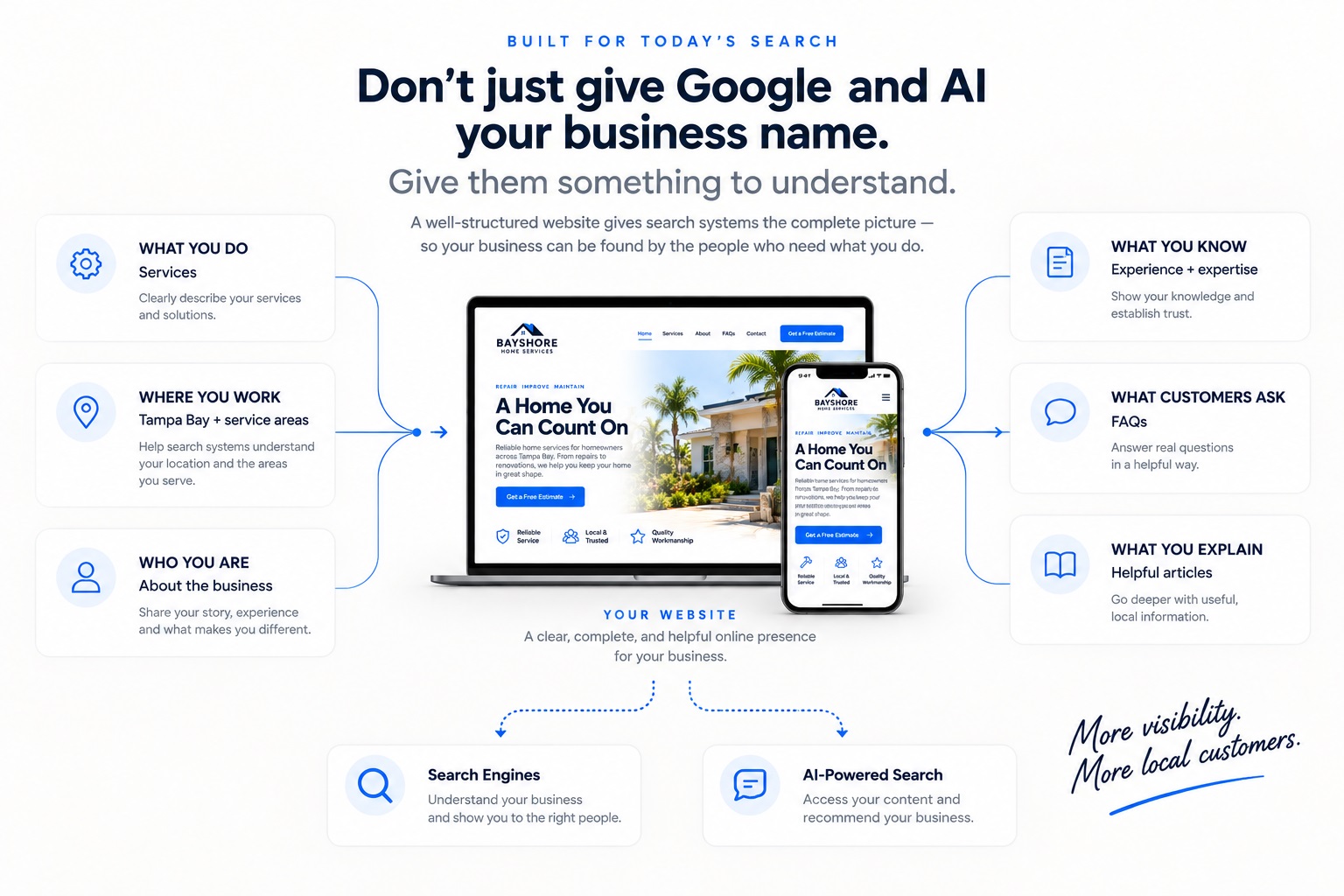
Every local business website should answer four fundamental questions.
Make the business identity, experience and relevant credibility easy to understand.
Explain important services clearly enough that someone can understand the problems the business solves.
Give customers and search systems meaningful geographic context about the areas the business actually serves.
Establish credibility and make the next step obvious once a potential customer decides the business may be a fit.
Build the Foundation
What should a small-business website actually include?
Instead of starting with an acronym or the latest search tactic, start with a strong website.
These fundamentals support customers first while also creating clearer information for search systems.
A credible visual experience that reflects the quality of the business.
Enough detail to understand what the company actually provides.
Meaningful geographic information where location matters.
Pages and internal links organized around what customers need to understand.
A site that remains clear and usable on the devices customers actually use.
Important pages should be available for search systems to crawl and index where appropriate.
Structure that clearly communicates the subject and hierarchy of the information.
Appropriate structured data can help search engines understand specific information represented on a page.
Search and analytics tools can help the business understand how the website is being discovered and used.
Make it easy for an interested visitor to call, inquire or take the appropriate next step.
Then Add Depth
A strong core website can be expanded with useful business knowledge.
A core website establishes the business. It explains who the company is, what it does, where it works and how to make contact.
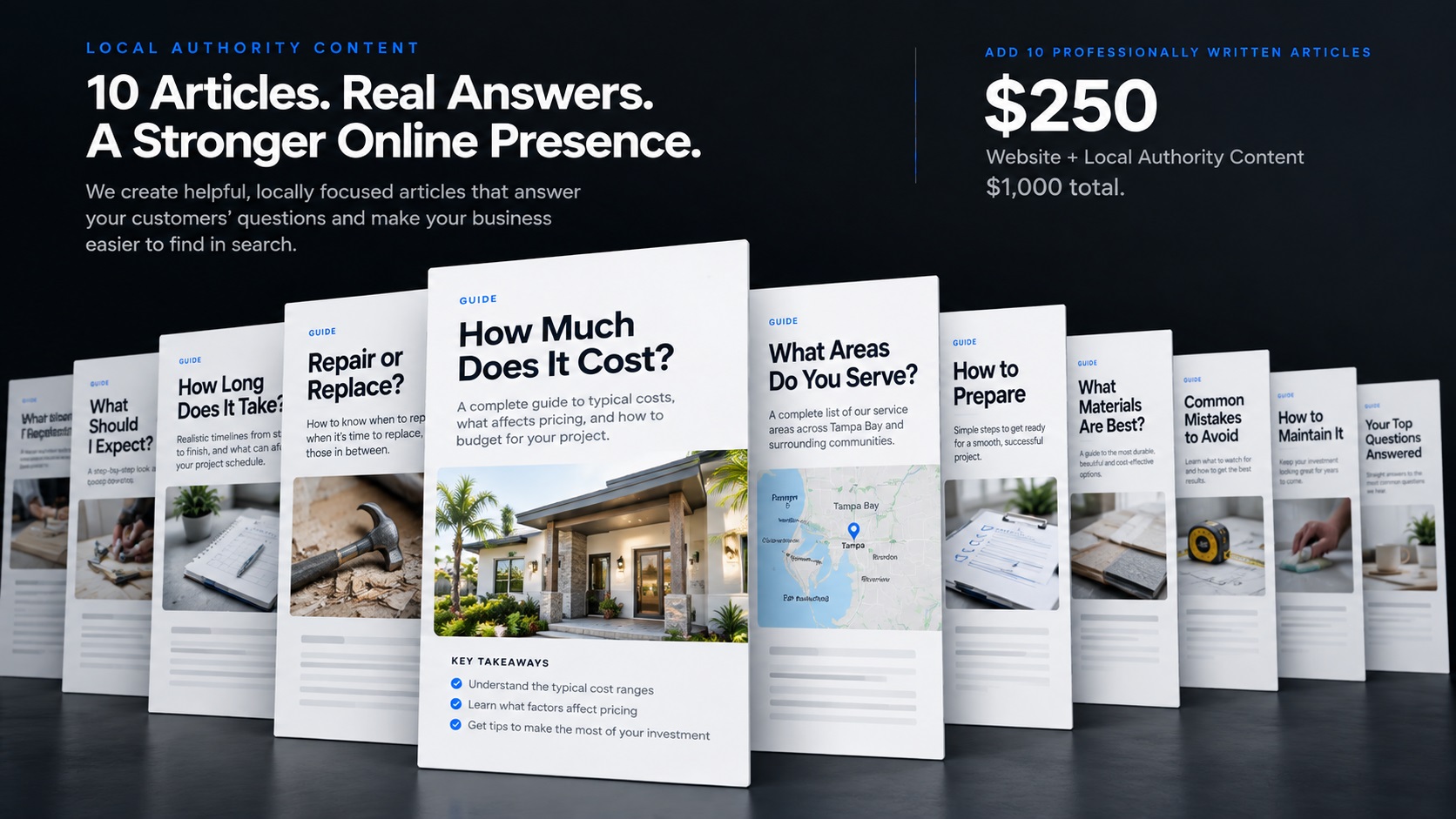
Useful supporting articles can add more information around customer questions, problems, services, decisions and expertise.
That additional information can help customers while also giving search systems more relevant business-specific material to discover and understand.
It does not guarantee rankings, traffic, AI citations, recommendations or leads.
What Not to Chase
New search technology does not make every new optimization tactic worthwhile.
Small-business owners should be particularly cautious when a complicated new tactic is presented as the secret to being “chosen by AI.”
No website provider can control whether an AI-powered system will cite, mention or recommend a particular business for a particular query.
More pages do not automatically create more authority. Large quantities of repetitive or low-value content can make a website worse rather than better.
Geographic relevance should come from meaningful business information and genuine market context—not simply replacing one city name with another across nearly identical pages.
Repeating phrases unnaturally does not make information more useful or make the business clearer to a customer.
Terms such as AI optimization, AEO or GEO should not distract from the more important question: does the website provide accurate, useful and accessible information?
Be cautious of any single technical addition presented as a guaranteed shortcut to visibility. Search systems evaluate information through broader systems and processes.
Don’t Lose the Business Objective
Search visibility is useful because it can create opportunities.
Ranking, appearing or being referenced is not the final business objective.
A local business ultimately needs potential customers.
That means the website needs to do more than become discoverable. It also needs to help the person understand the company, establish credibility and make contact easy.
Give potential customers and search systems opportunities to encounter the business.
Clearly explain what the business does and where it provides those services.
Present the business professionally and provide enough information for a customer to evaluate it.
Make the path from interest to inquiry simple once the customer is ready.
A Practical Small-Business Plan
If you want to prepare for both traditional and AI-powered search, start here.
Make sure the business, services, geography, credibility and contact paths are clearly represented.
Ensure the site is technically available for crawling and indexing and monitor it through appropriate search tools.
Use descriptive pages, headings and internal links so the relationships between services and supporting information make sense.
Expand the website around questions and subjects where the business has real knowledge worth sharing.
Update services, contact details, locations and important factual information when the business changes.
Use Search Console and analytics information to understand website discovery and visitor behavior without pretending every customer journey can be perfectly attributed.
Search systems will continue to change. A website that is useful, clear and credible to the customer has a more durable purpose than one built around a temporary trick.
The Get Social Simple Approach
We aren’t building for one search box.
Get Social Simple builds professional small-business websites around a broader objective: create a stronger digital footprint that helps customers and search systems understand the business.
That means professional presentation, clear services, meaningful geographic information, search accessibility, customer-focused content and obvious conversion paths.
The technology will keep changing. The need to clearly explain a good business should not.
Be discovered.
Be understood.
Be trusted.
Make it easy to take the next step.
SEO & AI Search FAQ
Common questions from small-business owners.
Is SEO becoming obsolete because of AI search?
No. Search experiences are changing, but fundamentals such as crawlability, clear website information, useful content and understandable site structure remain relevant. Google’s current guidance for its generative AI search features specifically continues to point site owners toward established search best practices.
Do I need a separate website for AI search?
No. A business should focus on making its existing website useful, accessible and clear. The same website can provide information to customers and support discovery through multiple search experiences.
Can a website be optimized specifically for AI?
A website can be improved so its information is clearer, more useful and easier for search systems to access and understand. But businesses should be cautious of anyone suggesting there is a guaranteed technique that forces an AI system to cite or recommend a particular company.
Does structured data help with AI search?
Appropriate structured data can help Google understand specific information represented on eligible pages. Structured data should accurately reflect visible page content and should be treated as one part of a broader search foundation—not a guarantee of visibility in traditional or AI-generated results.
Do I need an llms.txt file for Google?
Google’s current Search documentation says an llms.txt file is not needed for Google Search and does not positively or negatively affect Google Search visibility or rankings. Other services may use different mechanisms, so this is specifically about Google Search.
Can better website content help with both Google and AI search?
Useful business-specific content can provide more information around services, expertise and customer questions for people and search systems to discover and understand. That can support a broader search strategy, but it cannot guarantee rankings, traffic, citations or AI recommendations.
Should I create hundreds of pages to give AI more information?
No. More pages are not automatically better. Google specifically warns against scaled content created primarily to manipulate search rankings rather than help users. Create pages when they provide meaningful information and consolidate subjects when separate pages would substantially overlap.
What should a small business focus on first?
Start with a professional core website that clearly explains the business, services, geography, credibility and next step. Make sure it is technically accessible to search systems. Then expand it with useful information where additional customer questions and business expertise deserve deeper coverage.
Build a Stronger Digital Foundation
Don’t build for a search trick. Build a website that clearly represents the business.
Get Social Simple builds professional small-business websites designed to support lead generation by making the business easier for potential customers to understand, trust and contact—while creating clearer information for Google and AI-powered search systems to work with.