Small Business Content Guide
Do Local Businesses Still Need a Blog?
A local business does not need a blog simply to say it has one. But a useful library of customer-focused articles can expand what the website explains, demonstrate real expertise and create more relevant information for customers and search systems to discover.
Yes—if there is useful information worth publishing. A blog can help a local business answer customer questions, explain its expertise and build more depth around its services. Publishing articles simply to keep a calendar full is a different strategy—and usually not a very useful one.
First, Forget the Word Blog
The better question is: does your business have useful knowledge that belongs on the website?
For many established local businesses, the answer is yes.
A plumber answers the same questions about leaks, water heaters and clogged drains. A roofer explains storm damage, roof life and repair-versus-replacement decisions. A landscaper talks through irrigation, drainage, plants and maintenance.
Those conversations contain useful information.
Yet many business websites reduce years of practical knowledge to a homepage, an About page and a short list of services.
A useful article library gives that knowledge somewhere to live.
Don’t think of a business blog as an online diary. Think of it as an organized library of useful answers connected to the work your business actually does.
The Old Blogging Mindset
“We need to post something this week” is not a content strategy.
Many businesses learned to think about blogging as a publishing schedule.
Monday arrives. The website needs another post. Someone picks a subject, fills a page and checks “blog” off the marketing list.
That puts the calendar ahead of the customer.
A page should exist because it has something worthwhile to communicate—not simply because another week has passed.
Repeating the same surface-level information found on hundreds of other websites does little to show what this particular business knows.
Search topics matter, but useful content should still answer a question or solve an information problem for a real person.
Articles should connect naturally to relevant services, related information and an appropriate next step.
Think Knowledge Library
Give the business’s real-world knowledge a place to live online.
A strong content library grows outward from the business’s services and the conversations it already has with customers.
Answer the things customers repeatedly ask before deciding whether they need a service or who they should hire.
Explain symptoms, causes and situations that lead customers to begin looking for professional help.
Help customers understand choices, tradeoffs and the factors worth considering before making a decision.
Go deeper than a short service-page description and explain how the work relates to real customer situations.
Explain what customers should expect from a process, visit, estimate, repair, installation or project.
Share useful observations and practical knowledge that come from actually doing the work.
Where Should Topics Come From?
Start with the questions customers ask all the time.
An established business usually does not need to invent its first content topics from scratch.
The subjects are often already hiding inside phone calls, estimates, emails, text messages and conversations in the field.
Those questions are valuable because they connect customer needs directly with the business’s expertise.
What Useful Articles Can Do
A good content library can support several jobs at once.
Give potential customers useful information before they call, helping them understand the problem, service or decision more clearly.
Give the business room to show what it knows through useful explanations instead of relying entirely on claims such as “experienced” or “professional.”
Add useful information around services, problems, questions and related concepts that cannot all be covered naturally on a short core website.
Connect articles with relevant service pages and related resources, creating clearer relationships between information across the website.
Provide more business-specific information that AI-powered search systems can potentially discover, process and use when assembling answers. This does not guarantee inclusion or citation.
Give potential customers additional ways to encounter the business, learn from it, evaluate it and move toward an appropriate service or contact page.
More Than a Few Core Pages
The website establishes the business. The articles add depth around it.
A strong core website should clearly explain who the business is, what it does, where it works, why a customer should trust it and how to make contact.
Articles have a different job.
They create room to explain the questions, problems, terminology, decisions and expertise surrounding those services.
How Often Should You Publish?
Don’t let an arbitrary calendar determine what deserves a page.
There is no reason for a small local business to publish weak content simply to maintain a weekly schedule.
A more practical approach is to identify worthwhile subjects, answer them properly and continue expanding the library when there is genuinely useful information to add.
Existing articles should also be reviewed when information changes. Accuracy matters more than making an old article look new.
Publish because the subject deserves a useful answer—not because the calendar says another blog post is due.
When Not to Blog
More content is not automatically better.
A blog can become a liability when the objective changes from helping customers to manufacturing pages.
Fix unclear services, poor mobile usability, missing contact paths and confusing business information before trying to solve everything with articles.
A thin article created only to fill a publishing slot does not become valuable simply because it is new.
Traffic for unrelated subjects has little commercial value if the visitor has no meaningful reason to need the business’s services.
Similar topics should be consolidated when one stronger page can answer the subject more completely.
Production tools can help organize and shape information, but they should not invent experience, customer knowledge or business facts the company does not actually have.
Two Different Jobs
The core website and the content library should work together.
Establish the business.
Give a potential customer the essential information needed to understand and evaluate the company.
- Who the business is
- What services it provides
- Where it provides them
- Why customers should trust it
- How to take the next step
Build more around it.
Add useful information surrounding the services and the decisions customers make.
- Questions customers ask
- Problems customers experience
- Service-specific knowledge
- Choices and comparisons
- Real business expertise
The Commercial Purpose
The goal is not blog traffic. The goal is a stronger path into the business.
Useful information can introduce a potential customer to a business before that person is ready to make a call.
From there, the rest of the website needs to do its job: establish credibility, explain the relevant service and make contact easy.
Articles can support that path. They cannot guarantee that every reader will become a lead.
The need often begins before the customer has chosen a company.
The article introduces the business through expertise rather than a sales pitch.
Relevant internal links create a natural path to services, company information and other useful resources.
When the visitor is ready, a clear next step can turn interest into an inquiry.
What About Google and AI Search?
Useful articles give search systems more business-specific information to work with.
Search visibility is another reason a content library can be valuable, but it should not be confused with a guarantee.
Each useful article can add information around a service, customer problem, question or decision that the core website may not cover in detail.
That gives Google and AI-powered search systems additional accessible information through which they can potentially discover and understand the business’s expertise and subject matter.
Google continues to emphasize useful, people-first content rather than pages created primarily to manipulate search results.
Write something worth reading first. Then make sure the page is clearly structured, accessible, internally connected and easy for search systems to understand.
For a deeper explanation of this relationship, read Can Better Website Content Help Your Business Show Up in AI Search?
Before You Start a Blog
Make sure there is a useful strategy behind it.
- The core website clearly explains the business and its services.
- The business has real customer questions worth answering.
- Article topics relate directly to the services and expertise of the business.
- The business can contribute real knowledge rather than relying on generic summaries.
- Each article has a clear reason to exist.
- Articles can link naturally to relevant services and other useful pages.
- The information can be kept accurate when circumstances change.
- Quality will take priority over an arbitrary publishing schedule.
- The articles are written for customers first—not merely to fill search results.
- Success is evaluated as part of the broader digital footprint, not by article count alone.
Business Blogging FAQ
Common questions about blogs for local businesses.
Does every local business need a blog?
No. A business does not need a blog simply to have one. Content is most useful when the company has relevant customer questions, service knowledge and expertise worth explaining beyond what fits naturally on its core pages.
Does blogging help local SEO?
Useful articles can expand the relevant information on a website, create internal links and give search engines more content through which to understand topics connected to the business. That can support a broader search strategy, but publishing blog posts does not guarantee rankings or local visibility.
How often should a small business publish blog posts?
There is no universal schedule every local business needs to follow. A better approach is to publish when there is a worthwhile customer question or subject the business can answer well. Quality, relevance and accuracy are more useful objectives than filling a calendar.
Does Google prefer websites that publish new posts every week?
Businesses should not assume that simply publishing on a weekly schedule will improve rankings. Google’s guidance emphasizes helpful, reliable, people-first content. Publish or update information when doing so makes the website more useful and accurate—not merely to make it look fresh.
Can blog articles help with AI search?
Useful articles can provide AI-powered search systems with additional business-specific information to discover and understand. That may create more opportunities for the business’s information to be considered, but no article can guarantee an AI mention, citation or recommendation.
What should a local business write about?
Start with real customer questions, common problems, service decisions, comparisons, expectations and subjects where the business has practical expertise. Those topics usually provide a stronger starting point than generic industry news.
Can AI be used to help write business articles?
AI-assisted tools can help with research, organization, outlining and production, but they should not invent the company’s experience or replace accurate business knowledge. The finished information should be useful, accurate and representative of what the business actually knows.
Is ten strong articles better than fifty generic ones?
Article count by itself is not a meaningful measure of quality. A smaller collection of relevant, substantial articles based on real customer needs can be much more useful to the business and its customers than a large library created simply to increase page count.
Build More Around Your Business
Turn the questions your customers already ask into useful website content.
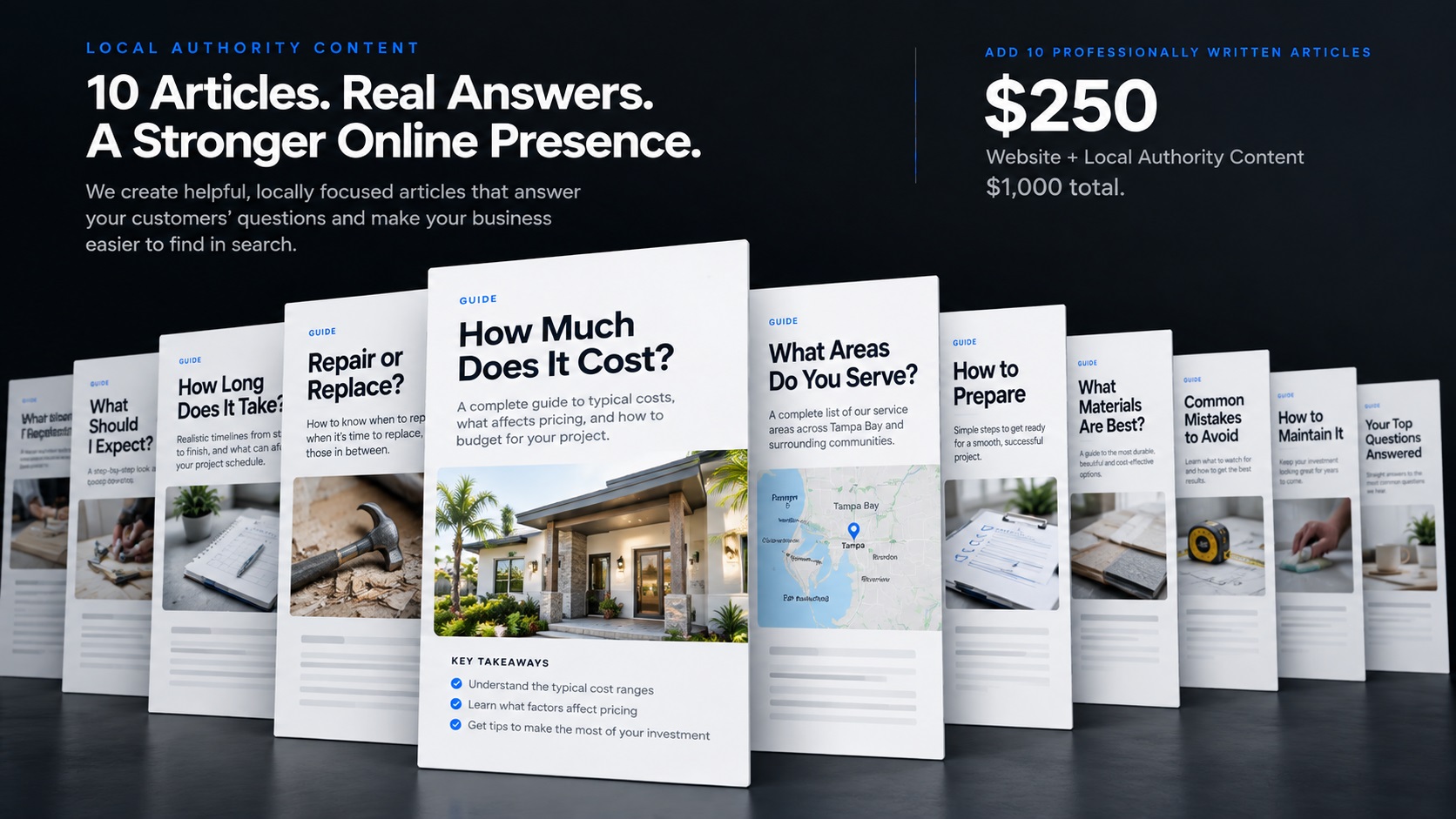
Local Authority Content helps turn real customer questions, services and business expertise into a focused information library that adds depth around your core website and strengthens your overall digital footprint.