Small Business Website Guide
7 Signs Your Small Business Website Needs a Redesign
A website does not need to be redesigned simply because it is old. It needs attention when it no longer represents the business well, makes important information difficult to understand or creates unnecessary friction between an interested customer and the company.
Sometimes the business has grown, improved and earned a strong reputation— but the website is still representing an earlier version of the company.
Does Old Mean Bad?
No. A redesign should solve a problem—not satisfy a calendar.
There is no rule that says a business website has to be replaced every two, three or five years.
If an older website still looks professional, accurately represents the business, works well on current devices, clearly explains the services and makes it easy for customers to take the next step, its age alone is not a good reason to rebuild it.
The more useful question is: “Is the website still doing the job the business needs it to do?”
If you would hesitate to send a good prospect to your own website because you are worried about the impression it will make, that deserves attention.
Here are seven signs that the problem may be large enough to justify a redesign rather than another small patch.
The Redesign Test
Seven signs the website may be working against the business.
The website looks less professional than the business really is.
This is one of the clearest redesign signals for an established business.
Maybe the company has been operating successfully for years. It has good reviews, real customers, experienced people and quality work—but the website still looks like something created when the business was much smaller.
A potential customer who has never worked with the company does not know that history. They can only evaluate what they see.
Outdated typography, weak images, cluttered layouts, inconsistent colors, generic stock imagery, broken visual elements or a site that simply feels less credible than the reviews and reputation surrounding the business.
It is difficult to use on a phone.
A prospective customer may be looking for a service while standing in a driveway, sitting in a car, dealing with a broken appliance or comparing companies from the couch.
If they have to pinch and zoom, fight tiny buttons, scroll sideways or struggle to find the phone number, the website is adding friction at exactly the wrong moment.
Responsive design is more than making a desktop layout smaller. The mobile version should make the most important information and actions easy to use on a small screen.
Open the site on your own phone. Without zooming, can you immediately understand what the company does and find an obvious way to call or make contact?
A new visitor cannot quickly understand what you do and where you do it.
Business owners already understand their own companies, so unclear website messaging can be surprisingly difficult to notice.
A first-time visitor needs context quickly. What kind of company is this? What services does it provide? What type of customer does it help? Where does it operate?
If those answers are buried behind slogans, vague language or an unclear navigation system, the website is forcing the customer to do unnecessary work.
Could someone unfamiliar with your business look at the first screen and accurately explain what you do and who you serve?
Important services or service areas are missing, outdated or confusing.
Businesses change. Services get added or removed. Geographic coverage expands. Priorities shift.
If the website still describes an older version of the business, potential customers—and systems trying to understand the website—may receive an incomplete picture.
This becomes more important when the website is expected to support discovery through Google and AI-powered search. Those systems need clear information about the business, its services and relevant geography.
Compare the website with what your company actually sells today. Are the most important services easy to find? Are the markets you genuinely serve clear?
The website gives customers too few reasons to trust the business.
A visitor who finds your company online may be evaluating several businesses at once.
The website should help them understand why your company is credible. That does not require exaggerated claims or a wall of sales language. It requires useful evidence.
Depending on the business, that might include experience, qualifications, business history, reviews, real photos, explanations of the process, guarantees where applicable, service information or simply a professional presentation that feels consistent with the company’s reputation.
If someone had never heard of your business before today, what on the website would make them comfortable contacting you?
An interested customer has to work too hard to contact you.
A website can look attractive and still do a poor job of supporting leads.
If the phone number is hard to find, contact forms are unnecessarily long, calls to action are vague or every page leaves the visitor wondering what to do next, the website is creating friction near the end of the customer journey.
Good conversion design does not mean covering every screen with aggressive buttons. It means making the next logical action obvious when the visitor is ready.
Pretend you are a customer who has decided to inquire. How many decisions and clicks stand between that moment and actually contacting the business?
The website is difficult to update, expand or build on.
A useful business website should not become a dead end.
Maybe adding a service requires rebuilding the navigation. Maybe no one knows how to edit the site. Maybe the platform is no longer supported. Maybe publishing a useful article is unnecessarily difficult.
Those limitations become more important if the business wants to expand its digital footprint over time with better service information or customer-focused content.
If you wanted to add a new service page or publish a useful answer to a common customer question next month, could the current website support it cleanly?
Reputation vs. Website
Your online reputation shouldn’t be worse than your real-world reputation.
This is especially important for an established local business with a strong review profile.
Imagine a customer finds a company with dozens or hundreds of positive reviews. The reviews create confidence. Then the customer visits the website and finds something outdated, confusing or unprofessional.
The website has now introduced doubt where the reputation had created trust.
A redesign does not need to make the company look flashy. It should make the online experience feel consistent with the quality and credibility the business has already earned.
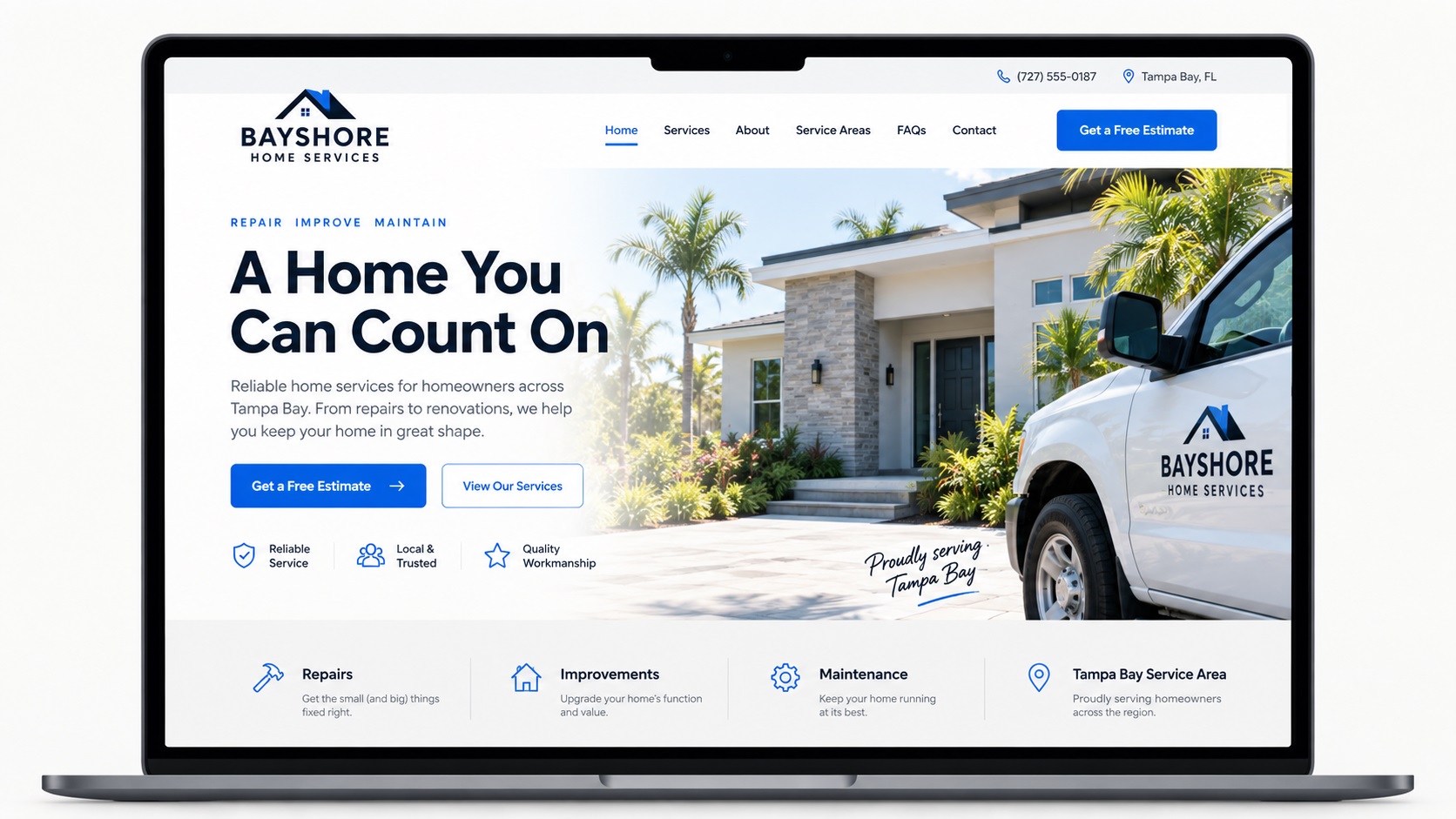
Sample website concept illustrating a professional digital presentation for a local service business.
Redesign or Repair?
Not every website problem requires starting over.
Sometimes the right answer is a focused improvement. Other times, repeatedly patching an outdated foundation creates more work than rebuilding it properly.
The foundation is still good.
If the site is structurally sound, works well on mobile and accurately represents the business, a weak headline, old image, outdated service description or confusing button may be fixable without a complete redesign.
The problems are connected.
If the design feels outdated, mobile usability is weak, information architecture is confusing, business information is incomplete and the site is difficult to expand, rebuilding the foundation may be more practical than repairing each problem individually.
A 10-Minute Website Audit
Look at your website like a potential customer would.
Business owners often view their websites with too much existing knowledge. Try evaluating the site as if you had never heard of the company before.
- Can I understand what the business does from the first screen?
- Is the geographic market or service area clear?
- Can I find the primary services without searching around?
- Does the site look professional on a current phone?
- Is the text easy to read without zooming?
- Are buttons and navigation easy to use with a thumb?
- Does the website give me reasons to trust the business?
- Does the information match what the company offers today?
- Can I easily find a phone number or inquiry option?
- Do I understand what happens after I make contact?
- Are there broken links, outdated information or obvious errors?
- Could the website easily support new service information or useful content?
Ask someone who is not deeply familiar with your business to spend one minute on the website and tell you what the company does, where it works and what they would do if they wanted to become a customer.
Why Redesign Matters
A redesign should improve more than appearance.
A professional design matters because it influences the visitor’s first impression. But appearance is only one part of the job.
For a service business, the stronger objective is to support the path from a potential customer’s need to a conversation with the company.
Give the business a clear, useful web presence that search systems can encounter and process.
Clearly communicate services, geography and the problems the business solves.
Present the company professionally and provide meaningful reasons for a prospect to feel confident.
Make the next step obvious once the visitor is interested in talking to the business.
A website redesign cannot guarantee more leads, higher rankings, traffic or AI mentions. It can improve the digital foundation supporting the moments when potential customers discover, investigate and decide whether to contact the business.
Search Understanding
An outdated website can also contain an outdated picture of the business.
Website redesign is often discussed almost entirely in visual terms. But the information architecture matters too.
Search engines and AI-powered systems encounter information on the website when trying to process what a business is about. Clear service descriptions, geographic context, logical page structure and useful business information provide better material through which to understand the company.
That does not mean redesigning a website automatically improves rankings or causes an AI system to mention the business. Those outcomes depend on factors no website provider controls.
It means a redesign is an opportunity to make the business itself clearer and more accurately represented online.
If you’re interested in how Google discovers a new or rebuilt website, see How Does Google Find and Index a New Business Website?
If the Website Has Outgrown the Business
Rebuild around the company you are today.
Get Social Simple builds professional small-business websites around the information potential customers need to understand, evaluate and contact the business.
The goal is not simply to make an old site prettier. It is to establish a stronger digital foundation.
Website Redesign FAQ
Common questions about redesigning a small-business website.
How often should a small business redesign its website?
There is no universal redesign schedule. A website should be evaluated based on whether it still represents the business accurately, works well on current devices, communicates clearly and supports the actions customers need to take. Age alone is not a reason to rebuild it.
Does an old-looking website hurt a business?
It can create a weaker first impression, particularly when the website looks less professional than the business’s reviews or real-world reputation suggest. The effect will vary by visitor and industry, but credibility is a valid reason to evaluate an outdated site.
Do I need a redesign if my website already works on mobile?
Not necessarily. Mobile usability is only one part of the evaluation. Also consider whether the site clearly explains the services and geography, represents the business professionally, provides useful trust information and makes contacting the company easy.
Can I keep my existing domain when redesigning my website?
In many redesign projects, the existing domain remains the business’s web address while the website behind it is replaced. The exact process depends on the current domain, hosting and website setup. Existing URLs should also be reviewed carefully so important pages are not removed or changed without a plan.
Will redesigning my website improve my Google rankings?
A redesign does not guarantee higher rankings. It can improve factors such as structure, mobile usability, content clarity and technical implementation, but search visibility depends on many factors. Existing URLs and search value should also be handled carefully during a redesign.
Can a redesigned website help generate leads?
A redesign can support lead generation by making the business easier to understand and trust and by reducing friction when an interested visitor wants to make contact. It cannot guarantee a particular number of leads because traffic, demand, competition and other factors also matter.
How much does a small-business website redesign cost?
Website redesign costs vary significantly depending on the scope, number of pages, content work, design, functionality and provider. See our Small Business Website Cost Guide for a detailed explanation of website pricing.
A Better Website for the Business You’ve Built
Your website should strengthen the credibility you’ve earned—not make a potential customer question it.
See how Get Social Simple approaches professional small-business websites built around clear information, modern search understanding and an easier path from interested visitor to potential lead.